


They'd Use It If They Knew About It: The Dissemination Problem in Mental Health Tools and a Model For Outreach
By: Muhammad Fariz Imran
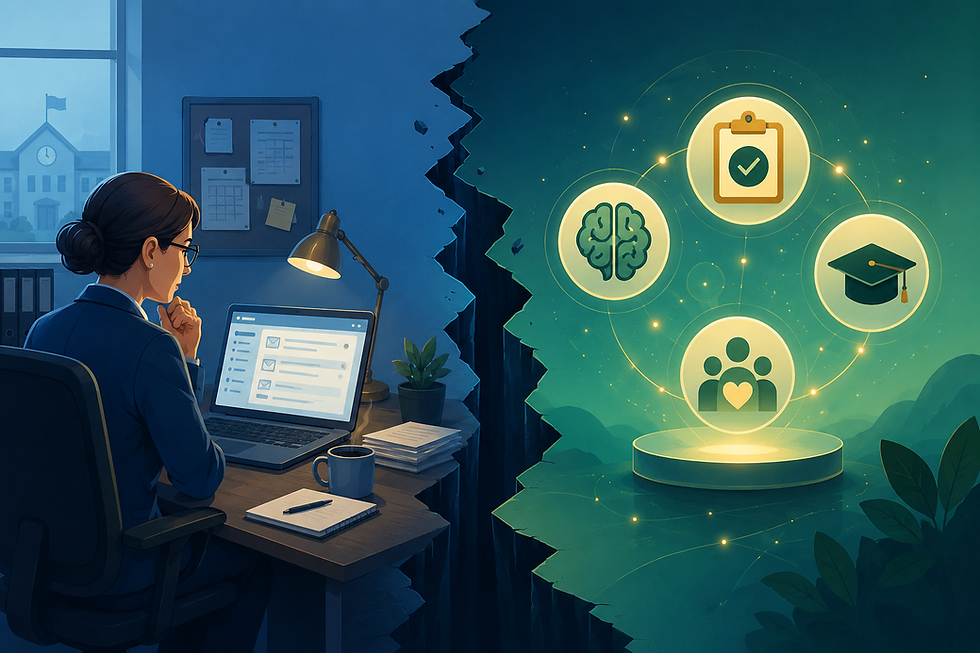
In a survey of over 64,000 educators, almost all endorsed a need for additional mental health skill-building tools for students, and following their review of a specific program, more than 80% said they would use it in their classrooms. Educator willingness, it turns out, is not the limiting factor. Building effective mental health tools for schools has attracted real investment; getting administrators and educators to discover, evaluate, and actually integrate those tools is a different problem—one that has received far less attention, and one where there are valuable solutions to be made.
The Current Picture
Youth mental health in K-12 has been in documented decline for over a decade. The CDC's Youth Risk Behavior Survey found that 4 in 10 high school students reported persistent sadness or hopelessness in 2023, with almost all indicators of health and well-being down from a decade earlier. Among students with a major depressive episode, a 2024 national survey by Substance Abuse and Mental Health Services Administration (SAMHSA) found that 40% received no treatment in the past year. Access is also unevenly distributed: almost 32% of white adolescents accessed mental health care in 2022-2023, compared to around 22-26% of Black, Hispanic, and Asian adolescents.
The Dissemination Problem
Evidence-based programs for school mental health now exist in real numbers. Researchers have spent years developing and testing them, and the literature supporting their effectiveness has grown. The more pressing question is whether any of that work actually reaches the students it was done for. Schools are where most of that reaching has to happen: A study using national survey data found that 57% of adolescents who accessed mental health services did so through an educational setting. In fact, underserved youth seem to be particularly dependent on their schools. Educators aren't just a source of understanding student mental health—they deliver our solutions.
The research community has started to formally document this connection and it’s importance as a common point of failure. Baker et al. (2021) introduced "dissemination science" as a distinct area of study within school mental health, organized around a specific observation: The field has invested heavily in implementation research—what happens after a school adopts a program—while largely overlooking how schools come to know about and want programs in the first place. A separate study in the same literature described the result plainly: Structural barriers between researchers and school staff make it difficult for practitioners to access and use research-supported tools, even when those tools have been validated and published.⁸ Even for schools already motivated to find programs, the Congressional Research Service has noted that identifying appropriate options "can prove challenging."
Part of this is structural. School counselors carry average caseloads of 400 students, and nearly 40% of U.S. school districts have no school psychologist on staff at all. These are professionals already stretched well beyond their original capacity, and finding time to evaluate and initiate adoption of new programs is not realistic for most of them. Returning to the opening survey, where the vast majority of educators were ready to adopt a mental health tool and expressed a need for them: Those educators were reached through organized outreach. They did not discover the program independently. Thus, what mental health solutions need for success is not just a solution, but effective outreach and dissemination—both personal enough to earn attention, and broad enough to address the problem at a meaningful scale.
What’s Missing
Outreach tools currently available tend to optimize for one dimension or the other. High-volume email platforms can reach many contacts with minimal manual effort, but they carry no relational memory and no sense of what a specific person needs to hear. This is fine for generic advertising, but not for outreach where establishing a connection and trust is critical. On the other hand, standard AI writing tools can sharpen individual messages, but they operate on a single email at a time and do not carry necessary context and objectives across a relationship, nor do they integrate cleanly with emails in a way that can enable partial automation.
A Model for Outreach
Mass outreach tools operate at scale but lose the individual. On the other hand, one-to-one correspondence preserves the individual but cannot scale. What's needed is a new model that holds both at once: Tool-assisted, outreach at scale where the unit of control is individual relationships, not a marketing campaign as a whole.
Such an architecture has two layers. The first is per-contact information: Who this person is, what institution they belong to, the history of the relationship, what has been discussed before, and where things currently stand. The second is a mission layer sitting above all the individual contacts in a given group, encoding the purpose of the outreach, what the organization is communicating and has to offer, and what it is asking people to do. Every message the system produces is informed by both.
The key feature is where control lives. Rather than setting an automation level for the system as a whole, the user configures it per contact. Some relationships warrant full autonomy: the system sends, tracks, and follows up without requiring intervention. Others warrant a draft-and-review loop, where a human approves before anything goes out. Others should stay entirely manual. This calibration reflects the actual state of each relationship: The degree of trust built, the sensitivity of the conversation, and how much judgment the moment requires. A contact engaged for months sits differently in this system than someone hearing from you for the first time.
Such a system does not broadcast to a list; it manages a portfolio of relationships at different stages, each with its own context and its own appropriate level of human involvement. Resultingly, we establish genuine scale without the relationship damage that purely automated outreach produces. The automation handles volume; the per-contact configuration preserves the quality that determines whether outreach actually converts to impact.
The Opportunity
The case for something like the model described here rests on a deceptively simple observation: The educators are ready, the programs are being worked on, and the problem is fundamentally one of infrastructure. An outreach system built around relationship-level control is a specific, structural answer to that specific problem. What remains is to prove the answer in practice.
Keywords: student mental health, automated outreach, AI, email marketing
References
Ali, M.M., West, K., Teich, J.L., Lynch, S., Mutter, R., & Dubenitz, J. Utilization of Mental Health Services in Educational Setting by Adolescents in the United States. Journal of School Health, 89(5), 393-401. 2019. Cited via https://jhr.uwpress.org/content/59/S/S256
Baker, E.A., Brewer, S.K., Owens, J.S., Cook, C.R., & Lyon, A.R. Dissemination Science in School Mental Health: A Framework for Future Research. School Mental Health, 13(4), 791-807. 2021. https://pmc.ncbi.nlm.nih.gov/articles/PMC8053372/
Browstein, M. "Adolescents' Use of Mental Health Services Unequal Across Racial Groups." July 8, 2025. https://hsph.harvard.edu/news/adolescents-use-of-mental-health-services-unequal-across-racial-groups/
Centers for Disease Control and Prevention. "Mental Health." Adolescent and School Health, 2024. https://www.cdc.gov/healthy-youth/mental-health/index.html https://www.cdc.gov/yrbs/dstr/pdf/YRBS-2023-Data-Summary-Trend-Report.pdf
Congressional Research Service. School-Based Mental Health: Introduction and Considerations for Congress. Report No. R48740. 2024. https://www.congress.gov/crs-product/R48740
Kuo, T., et al. "Youth Descriptions of Mental Health Needs and Experiences with School-based Services: Identifying Ways to Meet the Needs of Underserved Adolescents." Journal of Health Care for the Poor and Underserved, 28(3), p. 1191. 2017. https://doi.org/10.1353/hpu.2017.0105
Mader, J. "Opinion: Teachers and Students Are Not Okay Right Now." The Hechinger Report, January 29, 2024. https://hechingerreport.org/opinion-teachers-and-students-are-not-okay-right-now-more-mental-health-training-would-help/
Substance Abuse and Mental Health Services Administration. "Release of the 2024 National Survey on Drug Use and Health." SAMHSA Blog, July 2025. https://www.samhsa.gov/blog/release
Supporting School Mental Health Providers: Evidence from a Short-Term Telementoring Model. PubMed Central, PMC8804076. 2022. https://pmc.ncbi.nlm.nih.gov/articles/PMC8804076/
The Healthy Minds, Thriving Kids Project: Educator Perspectives on Relevance and Potential Impact of a Mental Health Skill Building Program. PubMed Central, PMC11932465, 2025. https://pmc.ncbi.nlm.nih.gov/articles/PMC11932465/
Comments